

Introduction
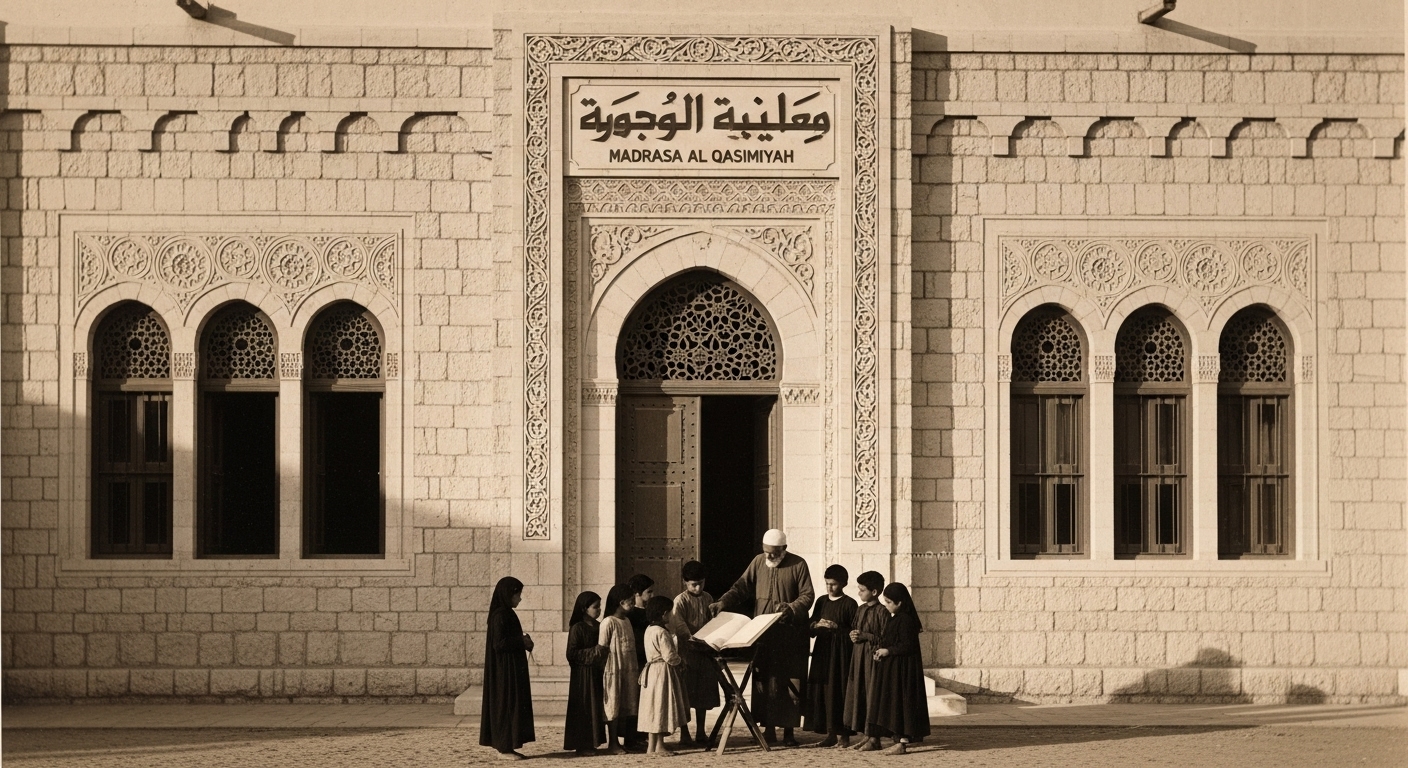
The year 1953 marks a watershed moment in the history of the UAE: the opening of Al Qasimiyah School in Sharjah. As the first modern, structured educational institution in the Trucial States, its establishment signaled the beginning of the end of educational isolation and the dawn of a new era. Al Qasimiyah was not just a school; it was a revolutionary idea—the idea that education should be systematic, broad-based, and accessible, preparing young people for the challenges of a changing world. Its story is the story of the first, courageous step on the path that would lead to a nationwide educational system and the creation of a modern, literate society.
History
The driving force behind Al Qasimiyah was the visionary ruler of Sharjah, Sheikh Sultan bin Saqr Al Qasimi. Recognizing that the traditional Katatib were insufficient for the demands of the 20th century, he allocated funds for the construction of a proper school building and recruited qualified teachers from other Arab countries, such as Palestine, Jordan, and Egypt, who brought with them modern pedagogical methods. The school opened with 450 boys aged 6 to 17, a massive enrollment that reflected a pent-up hunger for learning. Its success was immediate and profound, prompting the rapid establishment of similar schools in Dubai, Ras Al Khaimah, and Abu Dhabi throughout the 1950s, creating a ripple effect of educational modernization across the coast.
Key Features
Al Qasimiyah broke the mold of the Kuttab in several fundamental ways:
- A Structured Curriculum: For the first time, the curriculum extended beyond Quranic studies to include formal subjects like mathematics, geography, history, science, and English. This represented a monumental shift towards a holistic, worldly education.
- A Dedicated Facility: Unlike the adaptable spaces of the Katatib, Al Qasimiyah was a purpose-built school with classrooms, desks, blackboards, and a dedicated administrative office, creating a formal environment conducive to learning.
- Organized Administration: The school operated on a fixed schedule, with an academic calendar, standardized assessments, and a clear hierarchy of principal and teachers, introducing concepts of educational bureaucracy and standardization.
- Trained Teachers: The imported teachers were professionals with formal training, unlike the community-appointed Mutawa‘. They brought new teaching methodologies that encouraged understanding over pure memorization.
Cultural Significance
The opening of Al Qasimiyah was a powerful declaration of intent. It signaled that the leadership of the Trucial States was looking toward the future and understood that an educated populace was the key to progress. For the first time, education was presented as a public good and a state responsibility. For students, attending Al Qasimiyah was a transformative experience that opened windows to the world. It created the first generation of Emiratis with a modern skill set, who would go on to become the first teachers, administrators, and professionals of the nascent UAE federal government after 1971. The school became a symbol of hope and a tangible proof that change was possible.
Modern Relevance
Al Qasimiyah School laid the foundational model for the entire UAE school system. Its core structure—a broad curriculum delivered by professional teachers in a dedicated facility—remains the standard today. The school’s legacy is the thousands of students it educated, who became the builders of the modern state. Furthermore, its establishment triggered a cooperative spirit among the emirates; the sharing of resources and teachers in these early years fostered a sense of shared destiny that would be crucial for the success of the federation. The school building still stands in Sharjah as a protected heritage site, a physical monument to the moment when the UAE consciously chose the path of knowledge and modernization.
Conclusion
Al Qasimiyah School was the spark that ignited an educational revolution. It transformed the concept of learning from a private, religious undertaking into a public, secular necessity. The courage and vision required to found such an institution in a society with limited resources and no prior model cannot be overstated. It set in motion an unstoppable momentum towards universal education, a momentum that would be supercharged after the formation of the UAE. Al Qasimiyah stands as a proud reminder that the UAE’s towering achievements in education did not appear from nowhere; they began with a single school in Sharjah, a bold bet on the future that paid dividends for an entire nation.