

Introduction
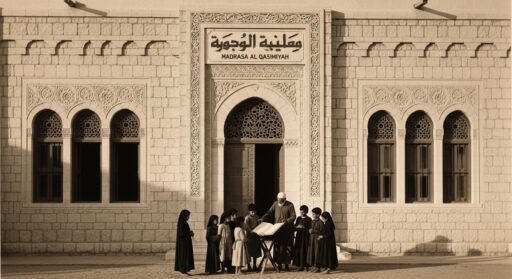
Before the establishment of a formal, state-run education system, the primary institution of learning in the Trucial States was the Katatib (singular: Kuttab). These traditional Quranic schools were the bedrock of knowledge, imparting not just religious instruction but the fundamental skills of literacy and numeracy to generations of Emirati youth. Operating in mosques, the majlis of a learned man, or even in the open air, the Katatib were more than just schools; they were community anchors that preserved Islamic identity and cultural values during a time of economic hardship and limited resources. Their story is the humble, yet profound, prelude to the UAE’s remarkable educational revolution.
History
The Katatib system had been the traditional form of education across the Muslim world for centuries. In the Trucial States, which lacked any formal government or infrastructure, these schools filled a critical void. They emerged organically within communities, dependent on the presence of a literate individual, often the Imam of a mosque or a respected elder, who would take on the role of the Mutawa‘ (teacher). Education was not compulsory, and attendance was often irregular, especially for boys who were needed to help with pearling, fishing, or herding. For the majority of the population, the education received at the Kuttab—primarily focused on memorizing the Quran—represented the entirety of their formal schooling.
Key Features
The pedagogy and structure of the Katatib were simple yet effective for their time and context:
- The Teacher (Mutawa‘): The Mutawa‘ was a revered figure in the community. His authority was absolute in the classroom, and his role extended beyond teaching to include moral and religious guidance.
- Curriculum: The core of the curriculum was the memorization (Tahfeez) of the Holy Quran. Students also learned to read and write Arabic, basic arithmetic, and the fundamental principles of Islamic faith and practice (Fiqh and Tawheed).
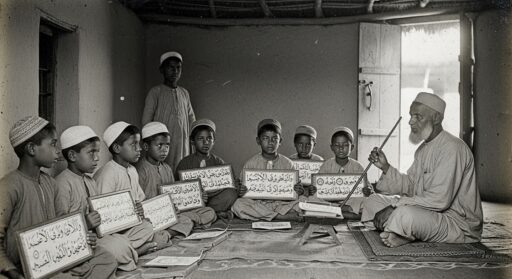
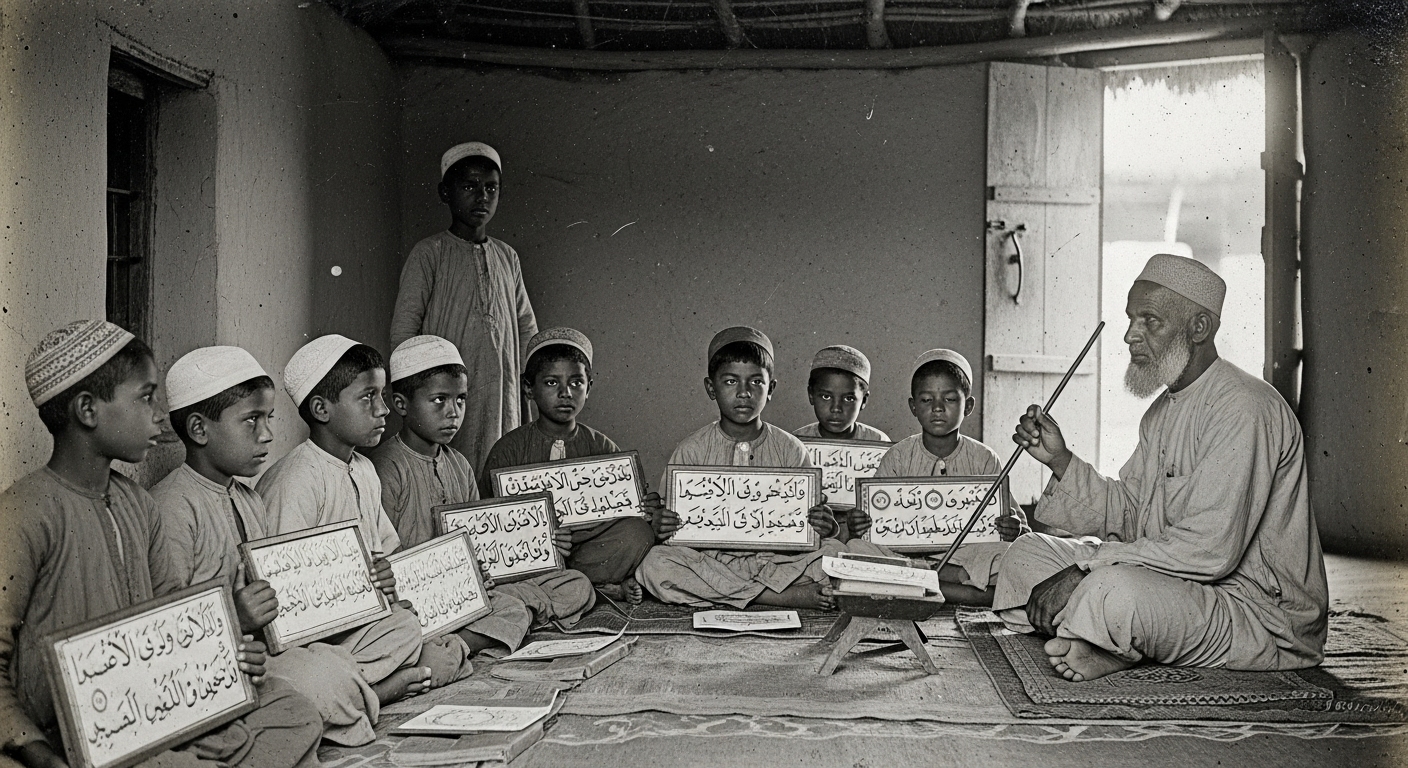
- Rote Learning Method: Instruction was based on repetition and recitation. Students would sit in a circle around the teacher, repeating verses until they were committed to memory. There was little emphasis on critical thinking or analytical skills; the goal was faithful transmission of sacred text.
- Physical Environment: Classes were often held in sparse settings. Students typically sat on the floor, using wooden slates (loh) and a special ink made from soot and gum arabic to practice their writing.
Cultural Significance
The Kuttab was instrumental in shaping the moral and social fabric of pre-union society. It was the primary institution for instilling Islamic values, ethics, and a sense of community responsibility. In a region with high illiteracy, the Kuttab produced the few individuals who could read and write, who then served as scribes, traders, and religious leaders. It provided a common cultural and religious foundation that transcended tribal differences, fostering a shared identity that would later prove crucial during the movement for federation. The respect for knowledge and the teacher, ingrained by the Kuttab, remains a deeply held value in Emirati culture today.
Modern Relevance
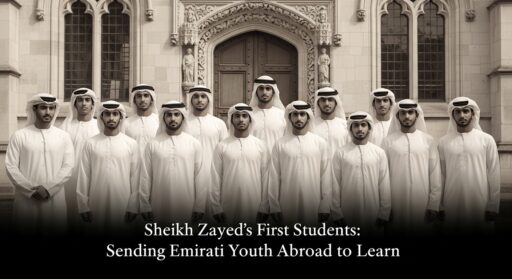
The legacy of the Katatib is twofold. On one hand, it represents the starting point of the UAE’s educational journey, a testament to a community’s commitment to learning even in the most challenging circumstances. On the other hand, its limitations highlighted the need for a modern, comprehensive education system. When the first formal schools opened in the 1950s, they built upon the foundation of literacy the Katatib had provided while radically expanding the curriculum to include sciences, mathematics, and world languages. Today, the Katatib model is preserved in modern Quranic memorization centers, but its historical role is honored as the genesis of the UAE’s unwavering belief in the power of education.
Conclusion
The Katatib were the quiet, steadfast guardians of knowledge during a chapter of Emirati history defined by scarcity. They ensured that the light of learning was never extinguished. While their methods and scope were limited, their cultural impact was immense, laying the ethical and communal groundwork for the nation to come. The journey from the simple Kuttab to the world-class universities of today is a measure of the UAE’s breathtaking transformation. The Katatib remind us that the nation’s current pursuit of knowledge and innovation is not a sudden phenomenon, but the flowering of a seed carefully planted and nurtured in the desert sands long ago.