

Introduction
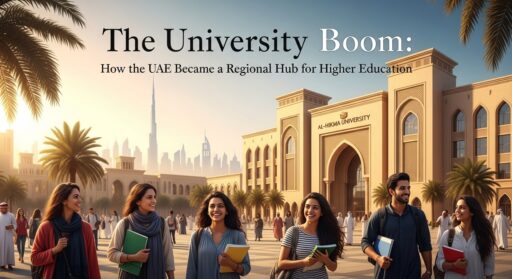
The transformation of the UAE’s higher education landscape is a story of explosive growth and strategic ambition. In a few short decades, the nation leapfrogged from having no universities to hosting a dense and diverse ecosystem of public and private institutions that attract students and faculty from across the globe. This “university boom” was a deliberate national project, designed not only to educate Emirati citizens but to position the UAE as a preeminent regional hub for knowledge production and innovation. The creation of this robust higher education sector is a cornerstone of the country’s economic diversification strategy and its quest to build a competitive, knowledge-based economy.
History
The foundation of the UAE’s higher education system was laid in 1976 with the establishment of the United Arab Emirates University (UAEU) in Al Ain by Sheikh Zayed bin Sultan Al Nahyan. It was the first and only comprehensive national university for years, tasked with producing the graduates needed to run the country. The next major milestone was the founding of the Higher Colleges of Technology (HCT) in 1988, which focused on practical, career-oriented education. The real “boom,” however, began in the early 2000s. The government actively encouraged the establishment of international branch campuses and private universities within specialized free zones, such as Dubai Knowledge Park and Abu Dhabi’s Masdar City, attracting prestigious institutions from the US, UK, and Australia.
Key Features
The UAE’s higher education sector is distinguished by its diversity and international character:
- Public Institutions: UAEU, Zayed University (established in 1999), and HCT form the public backbone, focusing on serving Emirati nationals and aligning their curricula with national development goals.
- International Branch Campuses: The UAE is a world leader in hosting branches of foreign universities, including New York University Abu Dhabi (NYUAD), Sorbonne University Abu Dhabi, and the University of Wollongong in Dubai. This offers students an international degree without leaving the region.
- Specialization and Research: There is a growing emphasis on research-intensive institutions, such as Khalifa University (a merger of several earlier institutions), which is now a globally ranked university focused on engineering and advanced technology.
- Regulatory Framework: The Commission for Academic Accreditation (CAA) under the Ministry of Education ensures quality standards across all private institutions, maintaining the sector’s reputation.
Cultural Significance
The university boom has had a profound socio-cultural impact. Campuses have become vibrant, cosmopolitan spaces where Emirati students interact daily with peers from around the world, fostering cross-cultural understanding and a global mindset. For Emirati families, the proliferation of local, high-quality options has reduced the need to send children abroad, keeping intellectual capital within the country. Furthermore, the focus on higher education has significantly advanced the role of women in society; Emirati women now vastly outnumber men in university enrollment and graduation rates, empowering a new generation of female leaders, scientists, and entrepreneurs.
Modern Relevance
The strategic importance of the higher education hub cannot be overstated. It is a key pillar of the UAE’s post-oil vision. By producing a highly skilled national workforce, it reduces dependency on expatriate expertise in key sectors. The research output from universities like Khalifa University and NYUAD contributes directly to national priorities in areas like artificial intelligence, renewable energy, and space science. Moreover, the education sector itself has become a significant economic contributor, generating revenue from tuition and living expenses of international students. It enhances the UAE’s soft power, projecting an image of a stable, forward-thinking nation committed to progress and open dialogue.
Conclusion
The UAE’s journey from one university to a thriving regional education hub is a testament to strategic planning and an unwavering belief in the power of knowledge. The university boom is more than just an expansion of infrastructure; it is the cultivation of an ecosystem designed to fuel the nation’s future. By creating a magnet for global talent and investing heavily in its own youth, the UAE has built a powerful engine for innovation and sustainable development. The lecture halls and research labs of its universities are where the next chapter of the UAE’s story is being written, ensuring that the nation’s future will be built not on oil, but on ideas.